Video lecture for this page
This material (including images) is copyrighted!.
See my copyright notice for fair use
practices.
As part of our search for life beyond the Earth, we try to understand how life began on the Earth, i.e. the origins of life on Earth, so that we can figure out how life might arise on another planet or moon. There is also the question of what will be the future of life on the Earth and the universe. However, whether you are looking for now-existing life or for how life began or at how the environment will affect life in the far future, you need to know what life is. Unfortunately, we don't have an universally agreed-upon definition of life. A couple of approaches that complement each other try to answer what is alive vs. not alive in the origins of life research: the "top-down" and "bottom-up" approaches. The top-down approach looks at all sorts of living and fossil life forms to figure out the most primitive forms that are or were alive. Unfortunately, all the life forms we know of are already very sophisticated. There is a big gap between the life forms we know of (either current or fossilized) and the never living material and reactions. The bottom-up approach uses laboratory experiments to mimic the emergent chemical processes of environments of ancient Earth or of current conditions on another planet (e.g., Mars) or moon (e.g., Europa or Titan) in order to create a self-reproducing chemical system. But debate still rages on what self-reproducing system would be considered truly alive.
We are limited by a sample size of one—the Earth—in figuring out what life is. All of the life forms on Earth share many common processes and features and therefore, seem to have evolved from a common ancestor. These common processes and features include such things as: (a) all life on Earth uses the "left-handed" version of amino acids to build the proteins it needs for carrying out the processes of life (look up "chirality" in a search engine for more on this); (b) all living cells use adenosine triphosphate (ATP) to store and release energy; and (c) the genetic code is used by nearly all cells in reading the information stored in the deoxyribonucleic acid (DNA) to build the proteins. These commonalities among all living things on Earth presents a challenge to us in looking for Life without an Earth bias.
Although an universally agreed-upon definition of life does not yet exist, there are some necessary characteristics of life (life as we know it). The following list of characteristics are necessary but not sufficient to define life. Many counterexamples of non-living things can be given for the characteristics.
-
Organization. All living things are organized and structured at the
molecular, cellular, tissue, organ, system, and individual level. Organization
also exists at levels beyond the individual, such as populations, communities,
and ecosystems. Possible counterexamples could be rock crystals, machines, and electronics. However, it is a nice characteristic because it is visible in a short amount of time and it can also
be used with past life.
-
Maintenance/Metabolism. To overcome entropy (the tendency of a
system to become more disorganized and less complex), living things use
energy to maintain homeostasis (i.e., maintain their sameness; a constant,
structured internal environment). Metabolism is a collective term to describe
the chemical and physical reactions that result in life. Although non-living things such as electrical or gas appliances use energy too, this characteristic is easy to observe in a short amount of time and the reactions could leave residues or changes in the environment that would tell us of past life.
-
Growth. Living things grow. The size and shape of an individual are
determined by its genetic makeup and by the environment.
Items 2 and 3 are related. Life grows by creating more and more order. Since
entropy is decreased (the amount of structure and complexity is increased), life
requires an input of energy. Life gains local structure
at the expense of seemingly chaotic surroundings on a large scale. Possible counterexamples could be fire and crystals. Looking for growth in living things might be hard to do if the life form grows slowly or has stopped growing and this characteristic cannot be used on past life.
-
Response to Stimuli. Living things react to information that comes
from outside or inside themselves. Counterexamples include rivers, clouds forming, or thermostats. While it is possible to see responses on a short time scale, we would need to know what the particular response is ahead of time to look for it and this characteristic would not be helpful in looking for past life.
-
Reproduction. Individuals reproduce themselves. Life also
reproduces itself at the sub-cellular and cellular levels. In some instances,
genetic information is altered. These mutations and genetic recombinations give
rise to variations in a species. Some possible counterexamples include some types of robots or computer codes or definite living things like mules that are the sterile offspring of a mated female horse and male donkey. "In between" cases like viruses and prions cause debates among biologists about whether they are truly alive. Viruses can reproduce only by infesting other life forms. Prions are infectious proteins that make copies of themselves by causing existing, properly formed proteins to change into the prion form rather than by actually replicating themselves (examples include "mad cow disease" BSE, and CJD in humans). The act of reproduction in truly living things is not always convenient to observe at a given time and it certainly will not work for past life.
-
Variation. Living things are varied because of mutation and genetic
recombinations. Variations may affect an individual's appearance or chemical
makeup and many genetic variations are passed from one generation to the next (heredity). Looking for heredity, though, requires a whole series of the organisms and perhaps a long time to see what trait is passed on vs. random chance, as well as, the inherited trait might not be readily visible.
-
Adaptation. Living things adapt to changes in their environment. Items
5, 6, and 7 are related. Life reproduces---complex structures reproduce
themselves. Life changes itself in response to natural selection on the
macroscopic level and to changes in DNA on the microscopic level. On the positive side, it is possible to use this characteristic when examining past life but on the negative side, it would take a long observation time to look for adaptation and evolution by natural selection.
Evolution by Natural Selection
Evolution was not a new thing in the time of Charles Darwin—there were scientists writing about evolution a hundred years before Darwin and there were ancient Greek thinkers such as Anaximander and Empedocles who thought that life forms change over time. Evolution is usually thought to have started with Charles Darwin because he developed a
plausible materialistic mechanism for evolution called natural selection. In the modern view of natural selection, individuals carrying genes (units of heredity consisting of a sequence of DNA bases) that better suit them to the current environment leave more offspring than individuals carrying genes that make them less adapted. Actually, the idea of natural selection was first formally published by Charles Darwin and Alfred Russell Wallace at the same time in 1858 but Charles Darwin had been developing the idea for over twenty years before then and sharing it informally with a few colleagues. After receiving an early draft of a paper from Wallace about Wallace's studies in the South Pacific that led Wallace to discover the process of natural selection, Darwin finally wrote up his own studies of evolution by natural selection in a formal paper that was presented to the public at the same time as Wallace's. Darwin then followed up the paper about a year later with a more complete and convincing argument for natural selection in his book, On the Origin of Species by Natural Selection. There are three basic observations and three basic conclusions leading to the idea of natural selection:
- Observation#1: There is variation among individuals of a species (item 6 above).
- Observation#2: Some of this variation is heritable. Darwin did not understand how heredity worked. The idea of heredity via genes was developed by the Austrian monk, Gregor Mendel, in the 1860s, but it wasn't until the 1940s that natural selection and Mendelian genetics were combined into the modern theory of evolution that guides the science of biology today.
- Observation#3: In general, more offspring are produced by species that can survive.
- Conclusion#1: Because of observation#3, there is competition among individuals for resources available to them to grow, survive and reproduce.
- Conclusion#2: Some variations will be more successful than others in allowing individuals to take advantage of these resources in a particular environment. These more successful individuals will be more likely to survive and to reproduce, leaving more offspring that share those successful adaptations for that environment. They are selected by the environment.
- Conclusion#3: Over time, for those traits that are heritable (we now know via genes), natural selection will cause species to evolve adaptations that are particularly well-suited for survival and reproduction in the given environment.
The theory of evolution gives a very plausible explanation for what we see in the fossil record of how organisms have changed over long periods of time and the sequence of those changes, for what we see of the developmental and structural remnants of past ancestry found in living species, and for what we see in the geographic distribution of plants and animals, especially in the case of oceanic islands. Of all the scientific theories, the theory of evolution, is the most controversial among the general public because of what it says about the development of Homo Sapiens, i.e., humans, and our relationship to the rest of the world. These controversies arise most often among those of particular religious views, but as I discuss in the first chapter, it is possible for religion and science to be compatible, even in the area of biological evolution. I offer a way to mesh the religion and science while honoring the truths of both in my Science-Religion Interface Resources site (this is not part of the Astronomy Notes textbook, so the link will appear in a new window).
Working Definition of Life
With the understanding that an universally agreed-upon definition of life does not exist, we can at least come up with a working definition to guide current research. One working definition from Gerald Joyce that guides NASA's research in astrobiology is "life is a self-contained chemical system capable of undergoing Darwinian evolution". Another similar definition from Max Coleman at NASA/JPL states "Life is a self-organized system capable of processing energy sources to its advantage." The focus on chemical systems and chemical energy rules out computer programs and robots or other electronic entities and it is more easily measurable. The first definition includes evolution because of the primacy of evolution in modern biology but it is very difficult (at best) to measure evolution in the time length of a typical space mission or grant. The second working definition focuses on the characteristics that can be easily measured quickly. Coleman notes that life usually processes energy at a different rate than its surrounding environment; that life must process energy more efficiently than its environment does or it will be out-competed by non-biological processes; and that self-organization separates life from its surroundings, isolating its chemical processing abilities from its environment.
Although we have always been aware that our knowledge of life is limited, the discovery of life surviving, even thriving, under conditions not usually studied in high school or undergraduate biology classes, made us confront our biases of what life should be like. Organisms that survive in extreme environments are called extremophiles. There are life forms that live in the "dry valleys" of Antarctica when the ice thaws for a few hours a day in the summer and in the sub-surface waters of Lake Vostok miles below the ice of Antarctica. There are life forms growing in boiling hot springs on the surface and miles beneath the ocean surface in pitch blackness near submarine volcanic vents. Bacteria have been found living in rock miles below the surface in deep mines where water has percolated into pores or cracks in the rock. In fact, the total mass of all the microbes living in the rocks miles underground (called endoliths) could be greater than the total mass of life forms on the surface!
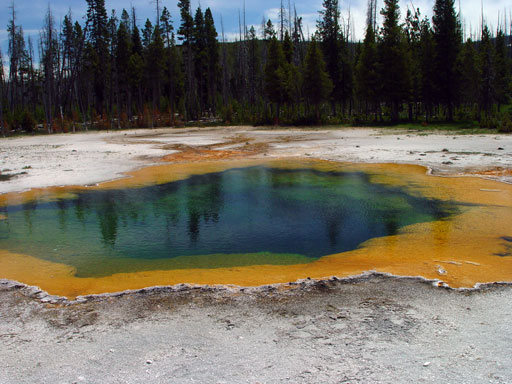
A hot springs at Yellowstone National Park. Different colors around the edge of the pool come from different types of bacteria living at different temperatures and acidity. Select the image to view a larger version. Other hot spring pictures are available in the Yellowstone photo album. |
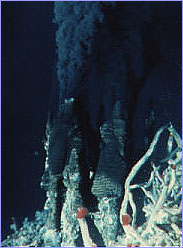 -- -- 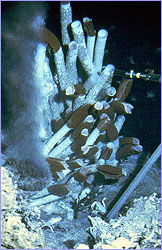
Life is abundant near deep sea volcanic vents far from any sunlight. |
Very hot conditions (up to 120º C), very cold conditions, very salty conditions, very acidic (low pH) conditions, very basic (high pH) conditions, and very high pressures: life is possible under all of these conditions as long as there is some liquid water. Other forms of life might be able to use another liquid but liquid water does have some advantages over other liquids as discussed in the next section. Current searches for extra-terrestrial life are focusing on places where liquid water could exist but our experience with extremophiles has taught us that life can be more creative than we can imagine with our biases.
NASA/JPL created a great classroom activity called “Looking for Life” that further explores the operational definition of life.
NASA's Astrobiology program created a
“Graphic History of Astrobiology” series
that includes an issue about Prebiotic Chemistry and the Origin of Life and
an issue about Biosignatures
that focuses on finding evidence of ancient life on Earth and Mars.
(Note that the link to the Prebiotic and Biosignature issues are to PDFs that will probably be moved soon to a different location, so
you may need to go to the top Graphic History link to find the new location.)
The primary illustrator of the Graphic History series is Dr. Aaron Gronstal, a PhD astrobiologist who is also an
excellent drawing artist, so the great illustrations are also scientifically accurate.
 Go back to previous section --
 Go to next section
last updated:
June 17, 2024
Is this page a copy of Strobel's
Astronomy Notes?
Author of original content:
Nick Strobel
