Video lecture for this page
This material (including images) is copyrighted!.
See my copyright notice for fair use
practices. Select the photographs to display the original source in
another window.
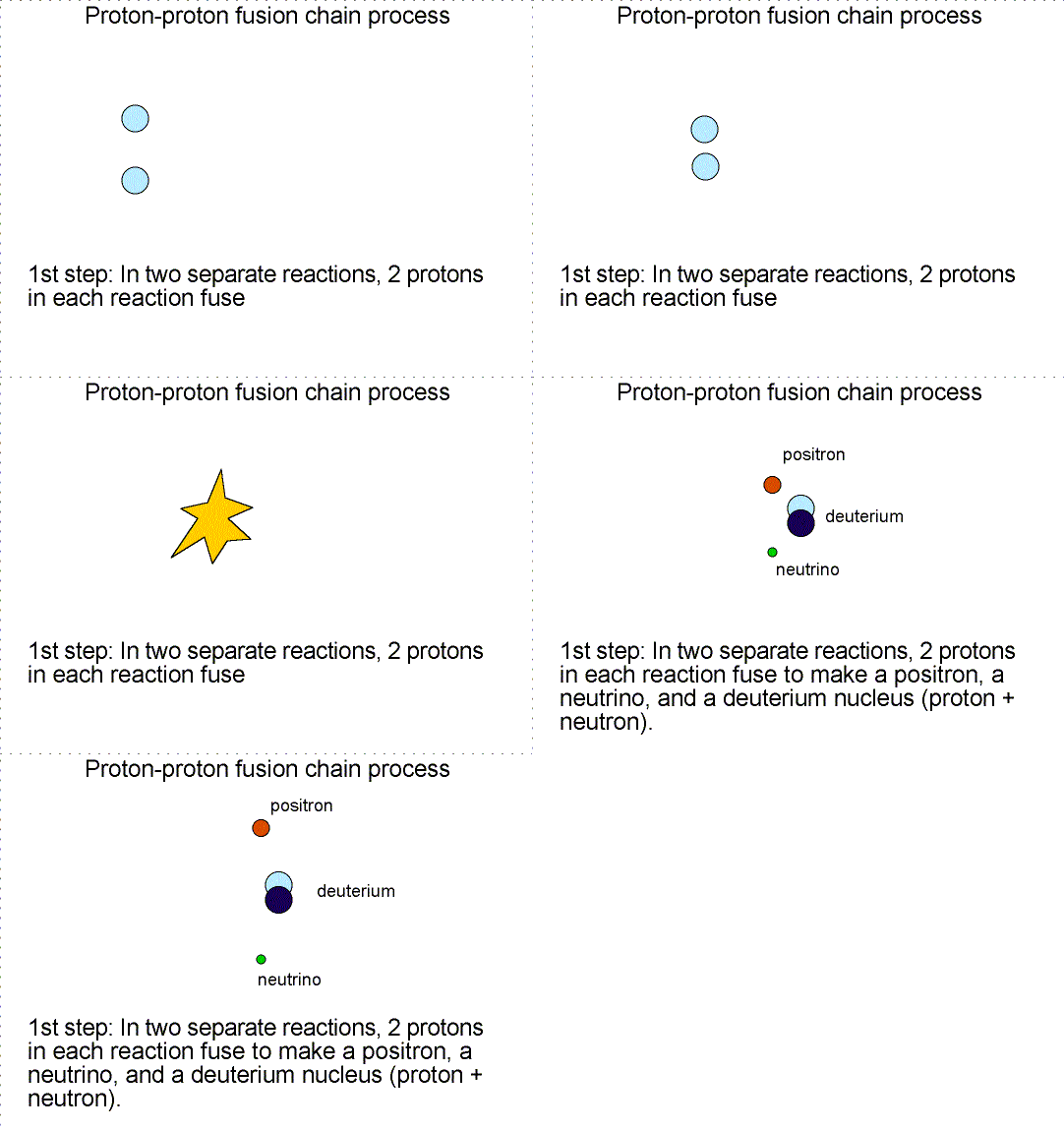
Helium is produced in the fusion of hydrogen. As shown in the proton-proton
fusion chain diagram above, there are two other particles produced. One is the
"positron" and the other is a "neutrino". A positron is the antimatter
counterpart of the electron. It has the same mass as an electron but the
opposite charge. When it collides with an electron, they annihilate each other
converting all of their mass into energy.
The photons produced in nuclear
reactions take about a million years to move from the core to the surface. The
photons scatter off the dense gas particles in the interior and move about a
centimeter between collisions. In each collision they transfer some of their
energy to the gas particles. By the time photons reach the photosphere, the gamma
rays have become photons of much lower energy---visible light photons. Because
the photons now reaching the surface were produced about a million years ago,
they tell us about the conditions in the core as it was a million years ago.
The other
particle produced in nuclear reactions has a less tortuous path out of the core.
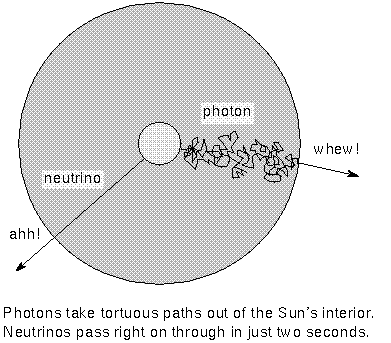
A neutrino is a very low-massparticle that rarely
interacts with ordinary matter. Neutrinos travel extremely fast---slightly less than the speed of light. Because they
travel so fast and interact so rarely with matter, neutrinos pass from the core
of the Sun to the surface in only two seconds. They take less than 8.5
minutes to travel the distance from the Sun to the Earth. If you could detect
them, the neutrinos would tell you about the conditions in the Sun's core as it
was only 8.5 minutes ago (much more current information than the photons!).
The problem with neutrinos is that they have a very low probability of
interacting with matter. A neutrino could pass through a light year of lead
and not be stopped by any of the lead atoms! However, there are A LOT of
neutrinos produced by the Sun. Take a look at your pinky finger. In one second
several trillion neutrinos passed through your pinky (did you feel
them?). Do not
worry, the neutrinos did not damage anything. The great majority of neutrinos
pass right through the materials around you.
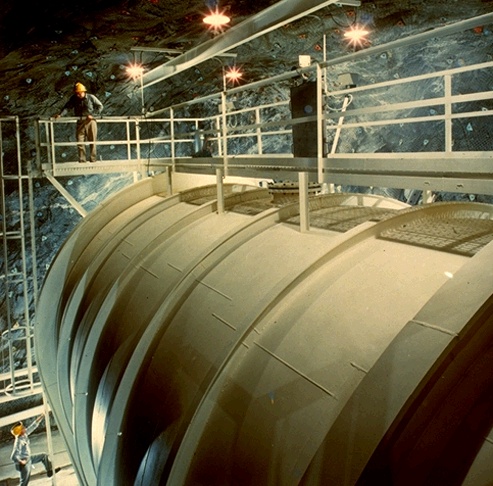
Homestake
Gold Mine Neutrino Experiment (courtesy of R. Davis, Brookhaven National
Laboratory).
A few of them will interact with some matter on
the Earth. You can increase the odds of detecting a few of them by using a LARGE
amount of a material that reacts with neutrinos in a certain way. A chlorine
isotope will change to a radioactive isotope of argon when a neutrino interacts
with it. In the same way a gallium isotope will change to a radioactive isotope
of germanium. Water molecules will give off a flash of light when
struck by a neutrino. Neutrino detectors use hundreds of thousands of liters of
of these materials in a container buried under many tens of meters of rock to
shield the detectors from other
energetic particles from space called cosmic rays. Even the largest
detectors detect only several hundred neutrinos in a year (compare that to the trillions of neutrinos that pass through you every second).
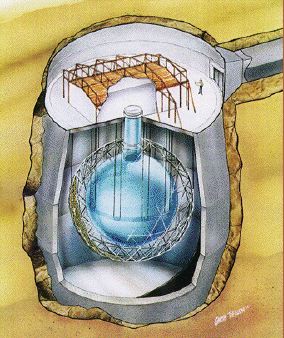
Sudbury Neutrino Observatory |
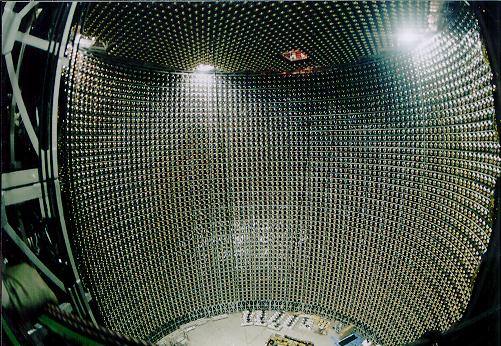
Super-Kamiokande Neutrino Detector water tank showing the thousands of photon detectors
each about the size of a beach ball. |
As shown in the animation describing the proton-proton chain above, the number
of neutrinos produced in the Sun is directly proportional to the number of nuclear
reactions that are
taking place in the Sun's core. The same can also be said of the number of neutrinos
produced via the Carbon-Nitrogen-Oxygen chain. The more reactions there are,
the more neutrinos are produced and the more that should be detected here on
the Earth.
The number of neutrinos detected coming from the Sun was smaller than
expected. Early experiments detected only 1/3 to 1/2 of the expected number of
neutrinos.
These experiments used hundreds of thousands of liters of cleaning fluid (composed
of
chlorine compounds) or very pure water. They were sensitive to the high-energy
neutrinos produced in less than one percent of the nuclear fusion reactions.
Later experiments using many tons of gallium were able to detect the more
abundant low-energy neutrinos. However, those experiments also found the same
problem---too few neutrinos (the gallium experiments found about 2/3 the
expected number). The puzzling lack of neutrinos from the Sun was called the
solar neutrino problem.
There were several possible reasons for this discrepancy between
the observations and our predictions:
- Nuclear fusion is not the Sun's power source. This reason was not supported
by other observations, so it was not likely to be the correct reason.
- The experiments were not calibrated correctly. It was unlikely that all
of the carefully-tuned experiments were tuned in the same wrong way. The experiments
used three very different ways to detect neutrinos and produced the
same lack of neutrinos. The experiments were independently verified by many
other scientists, so astronomers think that the results are correct, even if
they were
disappointing.
- The nuclear reaction rate in the Sun is lower than what our calculations
say. This was possible but many people checked and re-checked the physics
of the
reaction rates. There are some strong constraints in how much you can lower the
temperature in the core of the Sun to slow down the reactions. Astronomers know
how much total energy is emitted by the Sun, so they know very accurately how
many nuclear
reactions are needed to produce all of those photons seen coming from the Sun.
Those reactions also produce the neutrinos. Astronomers think they have a good
idea of how
stars produce their energy. That left another alternative.
- Neutrinos produced in the core of the Sun change into other types of
neutrinos during their flight from the Sun to the Earth. Our neutrino detectors
can detect a certain kind of neutrino, called the "electron neutrino", that
are
produced from nuclear fusion. Some of these electron neutrinos may change into
another of two types of neutrino (the "muon neutrino" or the "tau neutrino")
that do not interact with the detection material as well as the electron neutrino.
Some experiments in high-energy particle accelerators and the water tank Super-Kamiokande neutrino detector (Japan) suggested that the neutrinos could change into other
types. The Sudbury Neutrino Observatory (Canada),
using almost 900,000 liters of heavy water, was built to detect all three types
of neutrinos. It firmly established that some of the electron neutrinos produced
by the nuclear fusion in the Sun do change into the other neutrino types and that the solar nuclear fusion models do predict the correct number of neutrinos.
It looks like the 30-year mystery has been solved! The chief scientists for the Super-Kamiokande and the Sudbury Neutrino Observatory received the 2015 Nobel Prize in Physics for their discovery of neutrino oscillation.
A neutrino can change into another type of neutrino only if the neutrino has
some mass. If the neutrino has mass, then it cannot travel at the speed of light,
but it can get darn close. Recent experiments have shown that the neutrino does
have a tiny amount of mass (several million times less than an electron). A
neutrino with even as small a mass as this has important consequences for the
evolution
of the universe
(more about
that later) and
our understanding of the structure of matter. It is amazing that in their effort
to check their nuclear fusion theory, astronomers have learned totally unexpected
things about fundamental physics and this has changed what is known about the
structure and behavior of the entire universe itself. Wow!
Here are some links to the homepages of neutrino "observatories" that are in
operation around the world. All of the sites will be displayed in another
window.
- The Borexino detector uses
300 tons of liquid scintillator (an organic liquid much like mineral oil that gives off light when charged particles interact in it) to detect low-energy neutrinos produced in the Beryllium-7 electron-capture process in nuclear fusion in the Sun. It is buried far below a
mountain in Italy.
- The Sudbury Neutrino Observatory Plus (SNO+) will use 1000 tons of liquid scintillator (specifically, linear alkyl benzene, LAB) with dissolved neodymium buried far below ground outside of Sudbury, Ontario (Canada) to search for a particular neutrino reaction as well as being able to detect low-energy neutrinos. SNO+ is the followup to the Sudbury Neutrino Observatory that used 1000 tons of "heavy water" in the same container as SNO+. Heavy water uses the deuterium isotope of hydrogen instead of the
ordinary isotope of hydrogen in the water molecule (H2O). Deuterium has
1 proton+1 neutron in its nucleus instead of just the 1 proton of ordinary hydrogen. The
extra neutron makes deuterium twice as massive as ordinary hydrogen, so the "heavy water"
molecule is about 10% heavier than ordinary water. The original experiment is now finished and is being replaced by the SNO+.
- The
Super-Kamiokande experiment is
a joint-project of the United States and Japan. The detector uses 50,000 tons of water
buried deep underground in Japan. The link takes you to the
United States homepage at
the University of Washington. The
University of California at
Irvine is also involved in the project.
- KamLAND is a liquid scintillator detector in Japan in the Kamioka Mine 1 kilometer below the surface.
- The international Long-Baseline Neutrino Facility/Deep Underground Neutrino Experiment, hosted by the U.S. Department of Energy’s Fermilab, will use Fermilab’s powerful particle accelerators to send the world’s most intense beam of high-energy neutrinos to DUNE's massive neutrino detectors at the Sanford Underground Research Facility in South Dakota.
Two other sites worth exploring about neutrinos follow:
 Go back to previous section --
 Go to next section
last updated:
June 19, 2022
Is this page a copy of Strobel's
Astronomy Notes?
Author of original content:
Nick Strobel