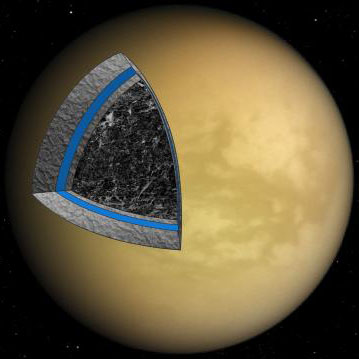
Saturn's largest satellite (of 60 orbiting Saturn) is the mysterious world called Titan. It has slightly greater diameter (5150 km), density, and mass than Callisto. At 1.22 million kilometers from Saturn, it takes 15.9 days to orbit Saturn. With a density of 1.881X water, Titan is probably half rock, half ice. Careful observations of how the Cassini spacecraft moved in Titan's gravity field have shown that Titan's interior is only partially differentiated (like Callisto). Below the frozen surface may be an internal ocean of liquid water (or water-ammonia mixture) sandwiched between two thick ice layers surrounding a rock-ice mixture core.
What is special about Titan is that it has a thick atmosphere with a surface air pressure about 1.5 times thicker than the Earth's. Even though Titan's mass is even smaller than Mars', it is so cold (just 95 Kelvin) that it has been able to hold on to its primordial atmosphere. The atmosphere is made of cold molecular nitrogen (95%) and methane (about 5%). Other organic molecules have been detected in its atmosphere. They are formed from solar ultraviolet light and high energy particles accelerated by Saturn's magnetic field interacting with the atmospheric nitrogen and methane. The molecules of nitrogen and methane are split apart (photodissociation) and the atoms recombine to make a thick haze layer of mostly ethane that blocks our view of the surface in visible light. When the droplets of the organic molecules get large enough, they rain down to the surface as very dark deposits of liquid methane and ethane. Methane bubbling up from below the surface is thought to replenish the methane lost in its atmosphere from photodissociation. The picture of Titan, Triton and the Moon at the end of this sub-section shows hazy Titan as viewed in visible wavelengths from the Voyager spacecraft. Unfortunately, Voyager's cameras were precisely tuned to the wrong wavelengths so it could not peer through the haze layer. Therefore, all it saw was an orange fuzz ball.
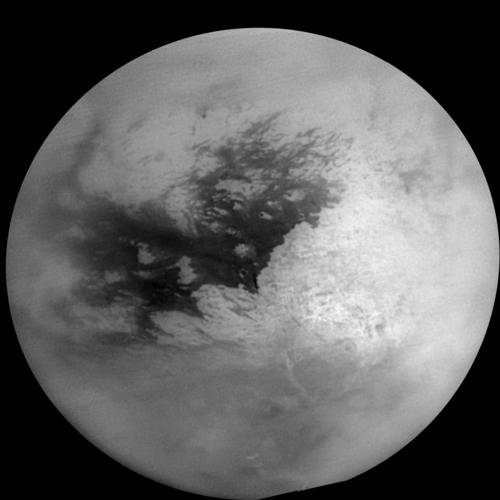
Titan's brew of organic compounds is probably like the early Earth's chemistry. Its very cold temperatures may then have preserved a record of what the early Earth was like before life formed. This possibility and the possibility of lakes or oceans of methane and ethane hidden under a haze of organic compounds made Titan the special subject of a Saturn orbiter mission to follow-up the Voyager fly-by mission. The Cassini spacecraft orbited Saturn for 13 years, flying by its numerous moons including over 100 targeted flybys of Titan. Using infrared wavelengths and radar, Cassini was able to peer through the hazy atmosphere. The picture below is a mosaic of 16 images taken at infrared wavelengths coming from the surface and that pass through the atmosphere easily to Cassini's camera.
Cassini managed to sample particles from the uppermost levels of Titan's atmosphere (many hundreds of kilometers above the surface) and found that there were traces of oxygen in Titan's upper atmosphere, probably from the photodissociation of water escaping Enceladus (see below) into hydrogen and oxygen. The presence of trace amounts of oxygen enables a greater variety of chemical compounds to be made with the energy of sunlight than just nitrogen and methane alone. Scientists simulating the conditions of Titan's upper atmosphere by mixing together simple compounds together under very low densities and bathing them with various wavelength bands of light have been able to create complex organic compounds, and an experiment reported in October 2010 (see also the LPL Spotlight article or the UA news release) produced all five of the nucleotide bases of life (adenine, cytosine, uracil, thymine, and guanine) and two amino acids (glycine and alanine) when a mixture of molecular nitrogen, methane, and carbon monoxide were subjected to microwaves. Early Earth with only trace amounts of oxygen in its atmosphere might have produced the first nucleotides and amino acids in the same way.
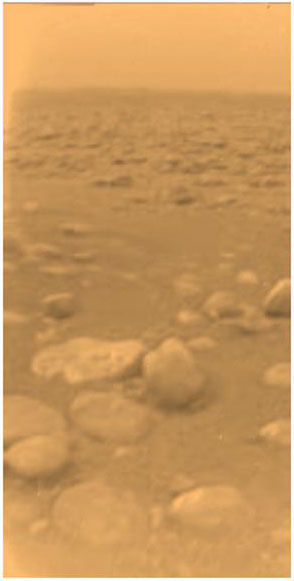
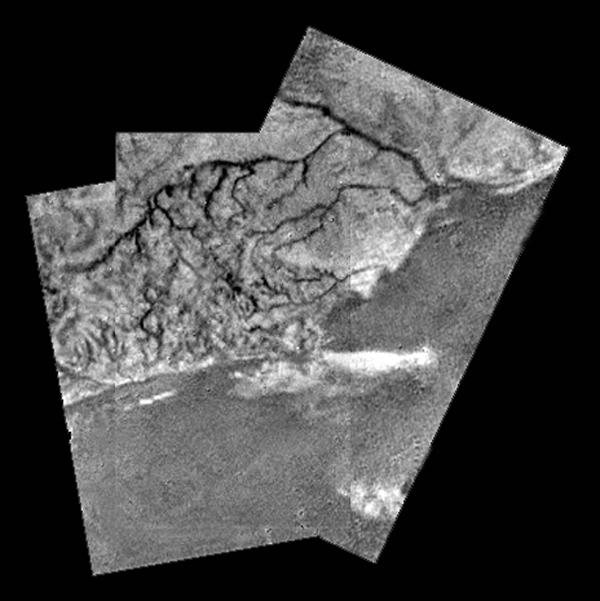
Another probe called Huygens, built by the European Space Agency, hitched a ride on Cassini and parachuted down to Titan's surface in January 2005. The color picture below (left) is Huygen's view from the surface of Titan. The probe settled 10 to 15 centimeters into the surface. The various landscapes of Titan look surprisingly familiar---like landscapes here on Earth. The mechanics of Titan's hydrogeological cycle is similar to the Earth's but the chemistry is different: instead of liquid water, Titan has liquid methane and instead of silicate rocks, Titan's rocks are dirty water ice. Liquid methane below the surface is released to the atmosphere to replenish that lost to the formation of the photochemical smog that eventually gets deposited in the soil. Methane rain washes the higher elevations of the dark material and it gets concentrated down in valleys to highlight the river drainage channels (see picture below right). Later images from Cassini revealed huge methane and ethane lakes that change shape, presumably from rainfall of liquid hydrocarbons (see also). Later images showed methane rain falling in the equatorial regions of Titan as spring unfolded in the Saturn system in late 2010. Besides erosion, Titan may have signs of tectonic activity (and see also) and volcanism (and see also). There are, of course, some impact craters but fewer than 100 have been seen---small bodies burn up in Titan's atmosphere and erosion, tectonics, and volcanism erase others. Its icy composition and its eccentric orbit might mean that tidal heating added to radioactive decay are enough to provide the internal heat (recall that water ice melts and flexes at lower temperatures than the rocks of the inner planets).
 |
 |
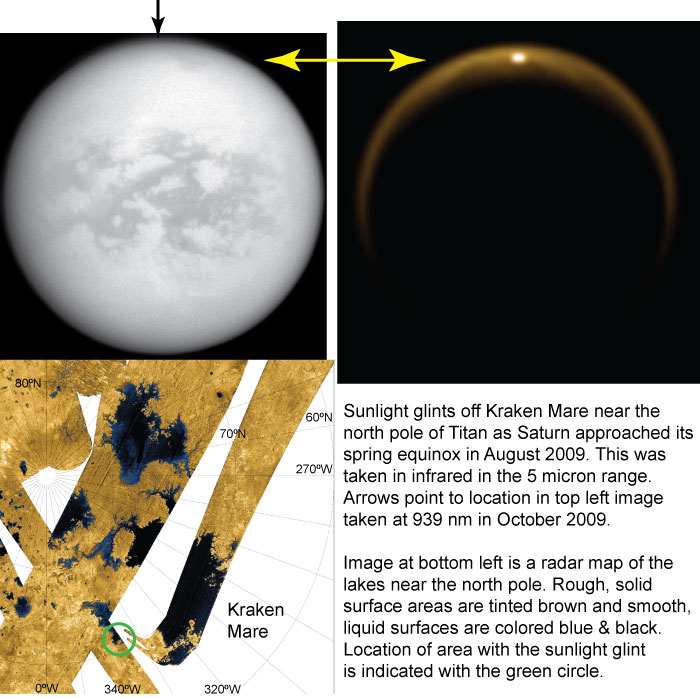
The montage below includes a radar map of the lakes near the north pole of Titan. They are filled with liquid ethane and methane and are fed from sub-surface seepage and rainfall. Looking a lot like lakes on the Earth, you can see bays, islands, and tributary networks. The large lake at the top of the radar map is larger than Lake Superior on Earth. Kraken Mare, of which a small portion of is visible in the lower left part of the map, is as big as the Caspian Sea on the Earth. There are also lakes near the south pole of Titan. [Data used to create the montage: 939 nm image, 5 micron glint image, and radar image.]
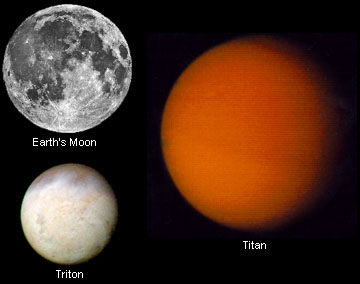
Titan,
Triton, and our Moon to the same scale.
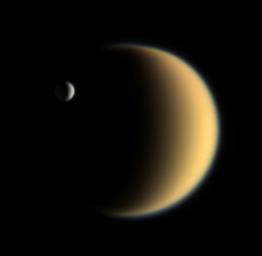 Enceladus is the fourth largest moon of Saturn at 504 km in diameter. It is shown in front of the much larger Titan in the image at left from Cassini. Enceladus orbits 238,000 kilometers from Saturn in 1.37 days. Despite its small size, Enceladus is a moon of large interest because it has the highest albedo of any major moon (1.0) and it is geologically active. Tidal heating supplies only a small amount (about 1/5th) of the internal heat for this moon. Simulations show that if Enceladus has a slight wobble in its rotation of between 0.75 and 2 degrees, the wobbling could generate about five times more heat than tidal heating as well as produce it at the observed locations of greatest heat in the fissures in its southern hemisphere. Geological activity is helped by Enceladus being mostly ice---its density is 1.61X water. Recall that ices can deform and melt at lower temperatures than silicate and metal rocks.
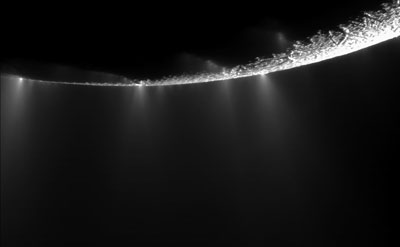
Enceladus has geysers spurting water (vapor and ice) from its south pole that point to a large ocean of liquid water below its icy, mirror-like surface. The geysers can be seen when one is on the other side of Enceladus looking back toward the Sun. The small particles scatter the sunlight forward toward the viewer. Geyser material is able to escape Enceladus and become part of the E-ring of Saturn. Enceladus' activity appears to be localized to the southern hemisphere. Its northern hemisphere has many more craters. Sampling of the geyser material has found salts (sodium chloride and potassium chloride) and carbonates mixed in with the water. That means the liquid water layer is in contact with the rocky core instead of being sandwiched between ice layers. If there is an ocean below the icy surface, should Enceladus be another place to look for life besides Europa?
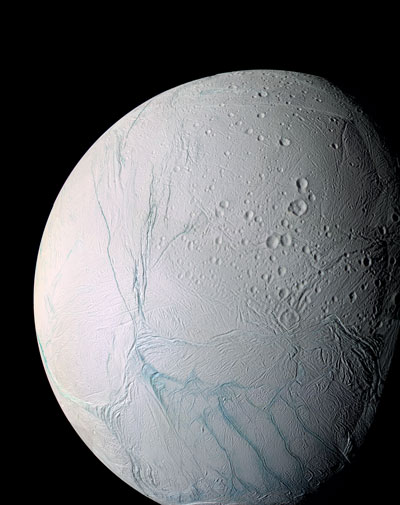
In this image above taken in November 2009, more than 30 individual jets shoot water vapor and ice up hundreds of kilometers from the south pole region. The south pole region of Enceladus is a stark contrast from regions further north in the image on the right. In this enhanced color view, the blue "tiger stripes" stand out. The "tiger stripes" are fissures that spray icy particles, water vapor and organic compounds. |
|
Triton has many black streaks on its surface that may be from volcanic venting of nitrogen heated to a gaseous state despite the very low temperatures by high internal pressures. The nitrogen fountains are about 8 kilometers high and then move off parallel to the surface by winds in the upper part of its thin atmosphere. Another unusual thing about Triton is its highly inclined orbit (with respect to Neptune's equator). Its circular orbit is retrograde (backward) which means the orbit is decaying---Triton is spiralling into Neptune. Triton's strange orbit and the very elliptical orbit of Neptune's other major moon, Nereid, leads to the proposal that Triton was captured by Neptune when Triton passed too close to it. If it was not captured, Triton was certainly affected by something passing close to the Neptune system.
 Go back to previous section --
 Go to next section
last updated: December 12, 2018