Answers to Global Warming Skeptics
The controversy over global warming is being fought over in the popular media even though the consensus of the
scientists who are actually researching climate change is that humans
are having a greater impact on global warming than natural sources. As a measure of the certainty of this, major insurance
companies take the Intergovernmental
Panel on Climate Change's conclusions into account in creating their business projections (see this report and others from google search).
Insurance companies know very well how to make money on projections
of real future events and they are not going to be swayed by any so-called "propaganda
from tree-hugging environmentalists"—if
the science conclusions are good enough for the insurance companies, then you
may want
to think twice, three times, many times, before discounting the IPCC conclusions. Even the U.S. Department of Defense recognizes that climate change is happening and that it will bring stresses on food and water supply systems. (See other DoD climate change links in a google search.)
You can take a look at the carbon dioxide and climate change data yourself from the links on the Online Trends page of the Global Monitoring Laboratory. Besides carbon dioxide trends, GML includes data on other gases that respond to infrared, role of the biosphere and oceans in the cycling of greenhouse gases, fossil fuel burning emission of carbon dioxide, effect of land use changes (deforestation, paving over, etc.), long-term climate trends, etc.
The overwhelming consensus of the scientific community (i.e., those
who are actively engaged in climate research, publish their results in peer-reviewed
journals, and allow their conclusions to be tested by others) is that the global
warming that is happening is mostly human-caused by the burning of fossil fuels.
Despite this consensus there is considerable debate among the general public.
There is a big disconnect between the scientists and the general public. The
popular
media
is usually
interested in fanning the flames of controversy instead of educating the public.
Therefore, they will look for opponents of the scientific consensus to provide
a "balanced view" and give equal credence to the global warming skeptics.
The voices of the few (unqualified) are magnified to be equal to the voices
of
the many. A short summary of the evidence and logic behind the conclusion that climate change is indeed happening and human activity is responsible for the majority of the change is my "How I Know" primer. It is a PDF that will print on one sheet of paper front and back.
Below are links to those who have compiled the arguments that counter the claims of the global warming skeptics BUT sociology research has shown that presenting a bunch of science arguments or data might not be the best way to convince the climate change denier. In January 2017, ScienceFriday ran a segment about the best ways to talk about climate change to those who deny it's happening. In the United States, there are six groups of people with regard to their views on climate change: one group is either alarmed (20% of population), one group is dismissive (10% of population), and other four groups are somewhere in the middle (70% of the population). The research has shown that science literacy and math ability are NOT correlated with how they view climate change---what matters is a person's political affiliation in how they assess the risk, i.e., staying within one's own "tribe" is more important for people on all sides of the issue. Probably the best way to convince someone is to find what other area of life you have in common with the person you're talking to and start from that point to build trust. (Link to local copy of the transcript of the ScienceFriday January 2017 segment.)
See also the episode "If I just explain the facts, they'll get it, right?" from Katharine Hayhoe's "Global Weirding" YouTube channel. She is a practicing evangelical Christian living in west Texas who is also a climate scientist, so she gets into the physical science AND the social science research and religious teachings about climate change.
With the warning of the previous paragraph in mind, here are links to those who have compiled the detailed counter-arguments and debunking of the claims of the global warming skeptics.
All of the links to external sources will appear in a new window.
-
Skeptical Science's Global Warming & Climate Change Myths has a list of over 170 (!) common myths or misconceptions sorted by recent popularity. It clearly shows the great creativity of people... The creator of the site now has a MOOC with freely available videos called "Making Sense of Climate Science Denial". It is a MOOC about how people think about climate change, so it includes the psychology behind the denial.
-
Global Weirding with Katharine Hayhoe YouTube channel about climate change for the non-scientist majority (alternate link globalweirdingseries.com). This is a YouTube playlist of twelve episodes covering the physical science of climate change, the social science research on why some groups of people deny climate change is happening and possible ways to persuade them, the religious teachings (primarily Christian) about climate change and why we should care, and what we can do to prepare for climate change and reduce the speed of climate change. Also, see the Global Weirding Facebook site for other videos and posts. Finally, see Bill Moyers' interview of Katharine Hayhoe of how she brings her evangelical Christian faith and her atmospheric physics researcher training together to talk about climate change in her Christian community.
-
Decoding the Weather Machine from PBS's NOVA. Broadcast in March 2018 is now available for streaming. Besides the usual segments going into the science of climate change, there are segments with evangelical Christian meteorologist Paul Douglas about how his faith and climate science are NOT at odds and how Norfolk, VA, home to the largest U.S. Navy base, is dealing with rising sea levels that already periodically floods parts of the city, cutting off personnel from getting to work.
- New Scientist's feature on climath myths and misconceptions called "Climate
change: A Guide for the Perplexed". The feature looks at 26
common myths in the global warming
controversy (remember the controversy exists primarily among the general public,
not the scientific community of climate researchers). (Links to New Scientist list updated Feb 2015)
- Any cooling disproves global warming
- Global warming stopped in 1998
- Antarctica is getting cooler, not warmer, disproving global warming
- Polar bear numbers are increasing
- The lower atmosphere is cooling, not warming
- The oceans are cooling
- Mars and Pluto are warming too
- Human CO2 emissions are too tiny to matter
- CO2 isn't the most important greenhouse gas
- Ice cores show CO2 increases lag behind temperature rises, disproving
the link to global warming
- Ice cores show CO2 rising as temperatures fell
- The cooling after 1940 shows CO2 does not cause warming
- It's too cold where I live - warming will be great
- We can't do anything about climate change
- Global warming is due to the Sun, not humans
- It's
all due to cosmic rays
- The 'hockey stick' graph has been proven wrong
- It's been far warmer in the past, what's the big deal?
- It was warmer during the Medieval period, with vineyards in England
- We are simply recovering from the Little Ice Age
- Warming will cause an ice age in Europe
- Higher CO2 levels will boost plant growth and food production
- Hurricane Katrina was caused by global warming
- Chaotic systems are not predictable
- We can't trust computer models of climate
- Many leading scientists question climate change
- It's all a conspiracy
- The leaked emails prove it's a conspiracy ("Climategate")
- They predicted global cooling in the 1970s
- Scholars and Rogues blog includes a detailed debunking of 21 myths put forward by global warming skeptics posted in 2007 by Brian Angliss. Some of the myths debunked are also in the New Scientist feature above but not all. One minor error, though, is Angliss said that the IPCC created the models. IPCC does not create the models; they use the results from the peer-reviewed models created by the climatologists. (Links updated Feb 2015.) Here is the list:
- Myth #1: All the CO2 in the air at present comes from the mantle.
- Myth #2: Increasing CO2 in the air is due to gases coming out of solution as the ocean heats up.
- Myth #3: Humans are not the source of the recent increase in atmospheric CO2 concentration.
- Myth #4: CO2 is rising at 0.38% per year, not 1% per year as the IPCC Third Assessment Report claimed.
- Myth #5: CO2 is such a weak greenhouse gas that it cannot be the cause of the observed warming.
- Myth #6: CO2 concentrations are not correlated with global temperature due to periods in the geologic history when CO2 was higher and the planet was in an ice age.
- Myth #7: Temperatures during the Medieval Warm Period were warmer than modern temperatures.
- Myth #8: The existence of the Medieval Warm Period has been ignored in order to support anthropogenic global heating.
- Myth #9: Modern temperature increases are a direct result of the Earth's climate exiting the Little Ice Age.
- Myth #10: Global cooling between 1940 and 1970 happened even though anthropogenic CO2 was rising.
- Myth #11: Cosmic rays hitting the earth are behind global heating.
- Myth #12: The Stefan-Boltzman law breaks the equations of global heating.
- Myth #13: Computer models are too inaccurate to accurately predict a system as complex as the Earth's climate.
- Myth #14: The oceanic storage of heat is required to account for the differences between data and early models. But the updated models still require an unrealistically large oceanic depth of water to make them work right.
- Myth #15: The oceans have already begun to cool in response to natural variations, so global heating is wrong.
- Myth #16: Satellite measurements of tropical air don't correspond to directly measured temperatures, so global heating isn't actually happening.
- Myth #17: Global heating will be good for the planet, not bad.
- Myth #18: Water vapor is a more powerful greenhouse gas than CO2, and since humans have almost no direct impact on the amount of water vapor in the air, humans can't be the cause of global heating.
- Myth #19: We don't have enough climate data to make valid predictions of any kind.
- Myth #20: Volcanoes spew more CO2 into the air in a single eruption than humanity has emitted in its history.
- Myth #21: Ice core data shows that CO2 has always followed an increase in temperature, so this is what must be happening now too.
-
"How
to Talk to A Global Warming Skeptic" by Coby Beck might
be helpful in figuring out how to talk with skeptics of global warming.
Beck is
not a climate researcher; he is an engineer working on artificial intelligence
but I think he provides a good layman's take on the debate in the general
public.
-
DeSmogBlog was
created to clear the public relations (PR) campaign that is trying to cloud
the climate change science. They are very familiar with
PR
tactics.
-
What we KNOW About Climate Change by Kerry Emanuel. Emanuel focuses on what is known beyond a doubt in this talk at the March 19, 2014 meeting of the MIT Club of Northern California now posted on YouTube. However, the "merchants of doubt" are at work in the comments that are below the video. Five main points of the talk (and then Q/A afterward):
- Earth's climate is not terribly stable (ice ages and Snowball Earth episodes in deep past).
- Climate science has a long and illustrious history (going back to Fourier and Tyndall).
- Human activities can and do have a strong effect on climate (pre-industrial levels of atmospheric carbon dioxide had been 280 ppm for thousands of years with slightly declining temperatures then spikes in both in industrial times).
- The idea that we are altering climate is based on much more than complex global models (stratopheric cooling is what we'd expect if increased carbon dioxide's greenhouse effect; mountain glaciers decreasing overall; Arctic sea ice extent decreasing even faster than worse case model predictions; increasing acidity of oceans; total hurricane power increasing; simple models give results in the middle of the range of predictions from complex models; etc.)
- Anthropogenic climate change is not controversial among climate scientists (those who actually do peer-reviewed climate research in 2013 poll results of climate scientists vs. what the general public thinks climate scientists say show that the "merchants of doubt" have done a very good job of sowing doubt among the general public).
-
University Corporation for Atmospheric Research (UCAR) Hot Questions about Climate Change gives quick answers to popular questions about climate change and then provides links for those who want a deeper background on global warming. See also their lighthearted video explaining how the addition of carbon dioxide is the "steroids of the climate system" by using steroids in baseball as an analogy. While one cannot attribute a particular extreme weather event to climate change, climate change does make extreme weather events more common so one has to look at an ensemble of events to determine if something is a bit out of whack. The video is available on YouTube.
-
NASA's Global Climate Change shows what NASA is doing to gather data from space on all of the pieces of the Earth system that determine the climate. The NASA Climate Blog is an excellent resource which includes commentary on the latest climate science by people doing the research.
-
The National Research Council's America's Climate Choices project is their most comprehensive study of climate change to date. You can download the PDF of their publications for free. The National Research Council is the working arm of the National Academy of Sciences established in 1863 by President Abraham Lincoln and whose members serve pro bono as advisors to the nation on science, engineering, and medicine.
Climate of Doubt from PBS's Frontline. Frontline broadcast this show in late October 2012 showing how public opinion shifted in the U.S. about climate change. The episode goes inside the organizations that fought the scientific establishment to shift the direction of the climate debate.
-
The
Truth About Denial feature article in the August 13,
2007 issue of Newsweek includes a history of the global warming denial
movement. (Online version no longer available.) A number of postings in the comments
area continue the same old denial arguments illustrating the strategy of
trying to win a debate by shouting louder than your opponent. The old denial
arguments are central to the "The Great Global Warming Swindle" discussed
below.
In March 2007, the British Broadcasting Company (BBC) broadcast a show called
"The Great Global Warming Swindle" that seemed to counter
all that "Inconvenient Truth" stuff from Al Gore, et al with experts
(including some with PhDs) claiming
that the human-caused global warming was just a scam. Unfortunately, the people who were swindled were the viewers of the BBC GGWS show. Though broadcast overseas,
it has been viewed by many thousands of people in the United States courtesy
of internet TV (and will probably be broadcast on the Fox channel sometime
soon). Needless to say, there were many problems with the "documentary".
Here are a few links
to critiques of
the
show:
-
Christopher
Merchant created a video point-by-point critique of the swindle show and posted it to Google Video in 2007. He has since updated his critique and you can view the video on YouTube at https://youtu.be/pxw3_XBvm94. Chrisopher
Merchant is a lecturer in Earth Observation in the School of GeoSciences
at the University of Edinburgh. His research interests are in remote sensing
and modeling of air-sea interaction. Merchant's analysis of the Swindle film
shows how the film's editor and speakers use every trick in the book to attempt
to deceive the viewers of the Swindle film. One logical fallacy Merchant points
out is that the film uses the fact that the Earth's climate has always been
changing (a correct statement) to "prove" that humans could not now be cause
global warming (an illogical conclusion). There are other errors in logic and rhetorical tricks used by the film makers that Merchant details in his video. He also shows how the film makers used a long-ago discredited science paper from the 1980s to make their case about the Sun being the cause---this paper is still being recycled in the climate skeptics internet postings. If you were to continue the flawed, incorrect analysis of that 1980s paper to today's data, you would see that the paper's Sun's "activity" index went down while the global temperature INcreased---something the film makers conveniently do not show even though the film was broadcast twenty years after the science paper was published.
-
George Marshall's posting "The
Great Channel Four Swindle" examines the
credentials and probable biases of the experts using in the Swindle show.
-
RealClimate's "Swindled!"
posting. RealClimate is a commentary site on
climate science by working climate scientists for the interested public and
journalists.
-
DeSmogBlog's
play-by-play critique. Also see Jim
Hoggan's editorial about the PR firms
involved in confusing the general public.
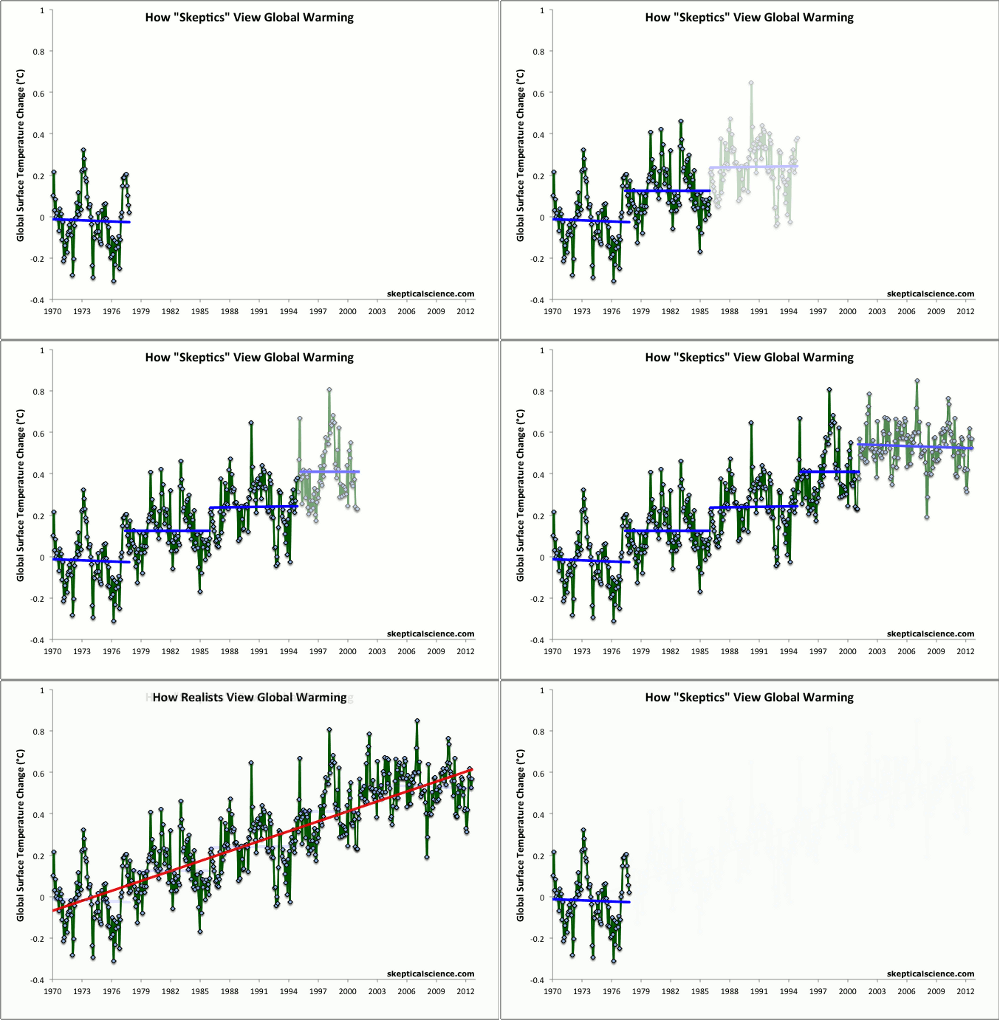
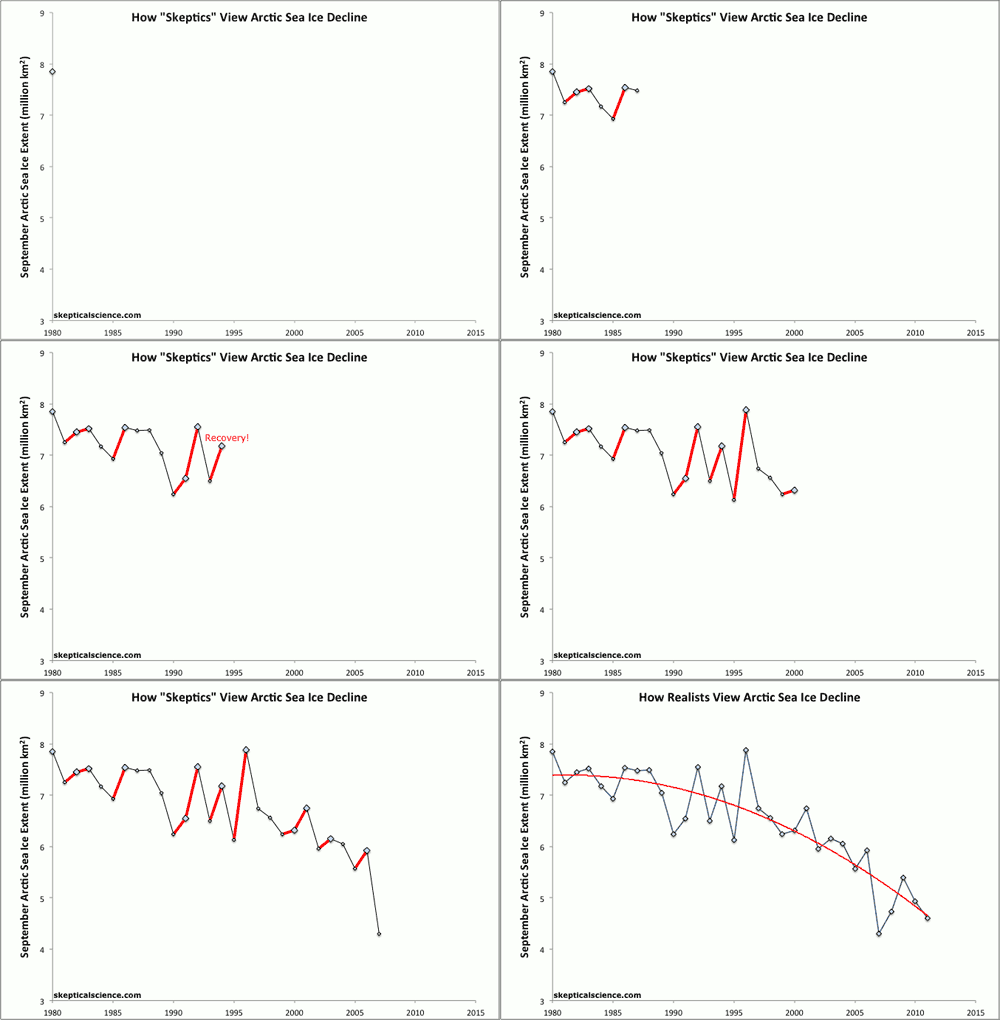
But It Has Cooled in the Last Decade! --- Going Down the Up Escalator
An often-used argument against the claim that the Earth is warming is that the temperature data show that the Earth has actually cooled in the past decade. If you cherry-pick your data, then yes, you can see that cooling trend but if you look at all of the data, the opposite trend appears. Also, remember the difference between weather (short-term wiggles) and climate (long-term averages). Here are a couple of popular examples highlighting the difference between trends using cherry-picked data vs. all of the data called "going down the up escalator".
Still Don't Agree with the Climate Change Scientists?
If you still think the conclusions of the IPCC and numerous other science
organizations are invalid, the climate science is flawed, etc., then how about
considering economic and national security reasons? Energy from fossil fuel
burning (oil, coal, natural gas, etc.) is getting more and more expensive since
it is a non-renewable resource that is shrinking while the demand for energy
is ever increasing. In 2018 the
US produced about 90% of the crude oil it consumed (this is "net imports" = imports minus exports, see the foreign oil FAQ at the EIA). A sizable
chunk of the United States supply of crude oil comes from countries that are politically
unstable
or
questionable
or
have
"less than warm" relations with the United States. While the top three crude oil exporters
are friendly to the U.S. (Canada, Mexico, and Saudi Arabia), the top
15 exporters list from the U.S. Department of Energy includes countries
such as Iraq, Russia, and Libya. The other exporters will also feel more
and more pressure to export to other countries such as China and India as their
energy needs grow as a result of their conversion to a Western-style economic
system. If you add in the health costs that arise from the respiration and
ingestion of the by-products of fossil fuel burning, the costs will be prohibitive
(especially as China and India ramp up to Western levels of per capita
consumption).
What Can You Do?
The world would get warmer even if we were to stop all fossil-fuel
burning now because of the time it takes for natural processes to get rid of
the human-generated excess of greenhouse gases (carbon dioxide, methane, nitrous
oxide and halocarbons). Does that mean it is hopeless? No. We can still prevent
the warming from becoming catastrophic. We can lessen the amount of eventual
warming. No one thing will be the answer that saves us. A number of simple,
smaller things added
together
will
be the
answer.
In the long run, the things we do now to slow the growth of greenhouse gas
increases
will
not
only
prevent
catastrophe,
it
will
save
us
a lot of money
and make the world more politically stable. Consider this like saving for retirement
or like investing in the stock market for the long-term: invest some money
now to reap a greater reward later.
- Try out your own mix of various solutions and scenarios with the En-ROADS simulator from Climate Interactive.
- The Princeton Environmental Institute has created a Carbon
Mitigation Initiative that divides up the difference between a "business
as usual" carbon rise and a stabilization at 2005 levels of carbon rise
into "Wedges" using currently available
technology that is commercially produced. Original Wedges (2004) paper by Steve Pacala and Rob Socolow (PDF). Since then, because of procrastination by society and a better understanding of what the target needs to be have shown that additional "wedges" are needed---humanity's emissions have been increasing faster than what Socolow and Pacala thought they would be in 2004 (mostly due to surging emissions in China from coal-burning).
- See "Rethinking Wedges" for an update on the wedge strategy. And, no, we don't get kudos in stabilizing our carbon emissions if we're importing (consuming) goods from countries that are not stabilizing their carbon emissions: the hidden consumption cost of carbon dioxide emissions.
- What you can do links
- Use or advocate for alternative energy sources such as solar power or wind. On my solar power photo album, I show the step-by-step installation of solar panels on my house and the rationale behind my financing of it. Also, through Property Assessed Clean Energy (PACE) legislation, you can install more energy-efficient heating and cooling systems while getting a sizable deduction on your income taxes. In California, the PACE financing is called the HERO program.
- Check out Science Moms who are a NONpartisan "group of climate scientists, who are also mothers, working to demystify climate change, talk honestly about its effects on our families, and give moms the info they need to help preserve the world for their kids."
- The NOAA and NSF's National Network for Ocean and Climate Change Interpretation (NNOCCI) is a network of individuals and organizations in informal education, the social sciences, and climate sciences. They are currently working in 184 institutions in 38 states reaching over 200 million people a year.
- Although we know that the oil company British Petroleum (BP) invented the "carbon footprint" to shift blame from the oil companies pumping oil to the individual consumer, a carbon footprint calculator can help us figure out the particular thing(s) we can do to have the greatest impact. The US Environmental Protection Agency (EPA) put out a nice carbon footprint calculator back in July 2016.
last updated:
October 18, 2024
Author of original content: Nick
Strobel